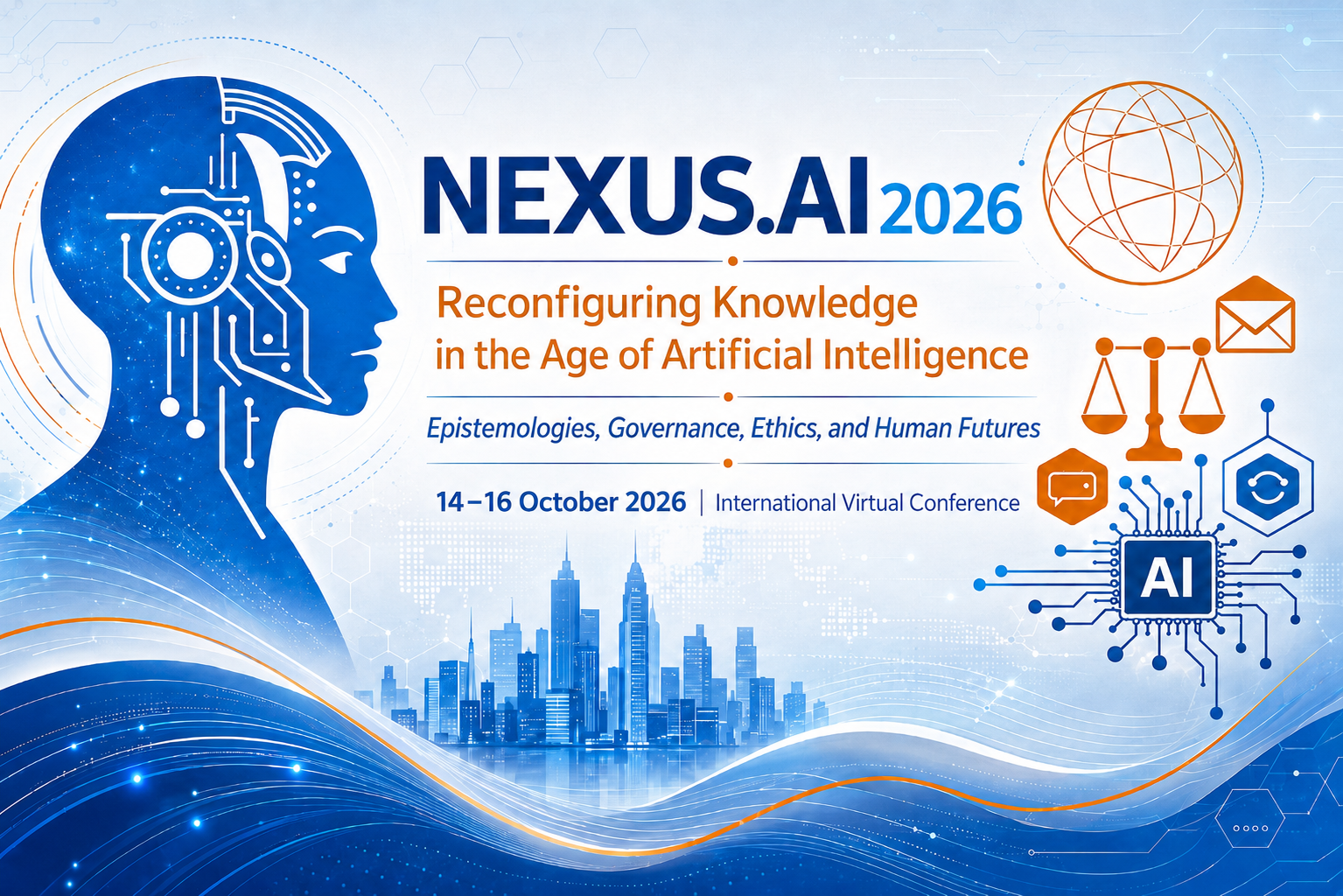
NEXUS.AI - Reconfiguring Knowledge in the Age of Artificial Intelligence, 14-16 October 2026
Organizers
- ”Andrei Șaguna” University of Constanța, Romania
- ”Dimitrie Cantemir” University of Târgu Mureș, Romania
- RK University, India
- Qiriazi University College, Albania
- NOVA THRACYA Centre for Policies and Applied Studies in Social Security
Scientific Committee
- Prof.univ.dr. Andra Seceleanu, ”Andrei Șaguna” University from Constanța
- Dr. Amit Lathigara, RK University, India
- Dr.Rajko Novićević, Faculty of Business Economics and Law, Montenegro
- Dr.Sandra Đurović, Faculty of Business Economics and Law, Montenegro
- Dr.Nikola Abramović, Faculty of Business Economics and Law, Montenegro
- Dr.Đorđije Pavićević, Faculty of Business Economics and Law, Montenegro
- Dr. Nirav Bhatt, RK University, India
- Dr. Paresh Tanna, RK University, India
- Dr. Chetan Shingadiya, RK University, India
- Conf.univ.dr. Nela Mircică, ”Andrei Șaguna” University of Constanța
- Prof.univ.dr. Ana Rodica Stăiculescu, ”Andrei Șaguna” University of Constanța
- Conf.univ.dr. Gabriela Munteanu, ”Andrei Șaguna” University of Constanța
- Conf.univ.dr. Ramona-Flavia Rațiu, ”Dimitrie Cantemir” University of Târgu Mureș
- Conf.univ.dr. Sorina-Mihaela Bălan, ”Dimitrie Cantemir” University of Târgu Mureș
- Prof.univ.dr. Brîndușa Gorea, ”Dimitrie Cantemir” University of Târgu Mureș
Organizational Committe
- Bianca Garabet, ”Andrei Șaguna” University of Constanța
- Irina Șunda, ”Andrei Șaguna” University of Constanța
- Cristina-Luiza Erimia, ”Andrei Șaguna” University of Constanța
- Andreea Mihaela Ilincuța, ”Andrei Șaguna” University of Constanța
- Ramona Dună, ”Andrei Șaguna” University of Constanța
- Andrei Murgu, ”Dimitrie Cantemir” University of Târgu Mureș
- Lăcrămioara Cojocariu, ”Dimitrie Cantemir” University of Târgu Mureș
Call for Papers
NEXUS.AI 2026 invites scholars, researchers, practitioners, and advanced doctoral candidates from across disciplines to contribute to an international, peer-reviewed hybrid conference dedicated to one of the most consequential transformations of our time: the reconfiguration of knowledge, governance, and human agency in the age of artificial intelligence.
👉 Registration Form: https://app.oxfordabstracts.com/stages/83307/submitter
Artificial intelligence has become a structural condition of contemporary societies. It mediates communication, reorganizes cognition, reshapes institutional decision-making, and increasingly participates in legal, managerial, and geopolitical processes. As AI systems generate, filter, and validate information, the epistemic foundations of modern societies—how truth is produced, governed, and contested—are undergoing profound transformation.
What is at stake is not merely technological innovation, but authority, responsibility, legitimacy, and public trust in AI-mediated environments. NEXUS.AI 2026 is conceived as a space of rigorous intellectual engagement rather than consensus. The conference explicitly encourages critical dialogue across disciplines, methodologies, and normative positions, recognizing that the complexity of AI-driven transformations cannot be addressed through siloed approaches or simplified narratives.
Conference Focus
The conference explores how artificial intelligence reshapes:
- knowledge production and epistemic authority
- law, regulation, and accountability
- organizational governance and strategic management
- communication, cognition, and psychological well-being
- public trust, institutional legitimacy, and resilience
- international relations, security, and crisis governance
Key Themes and Critical Topics
We welcome conceptual, empirical, normative, and applied contributions, including (but not limited to):
- AI and the Transformation of Knowledge
Machine-generated knowledge, epistemic authority, truth validation, synthetic evidence, epistemic risk, governance of knowledge in algorithmic environments. - AI-Mediated Communication and Emerging Psychopathologies
Algorithmic anxiety, cognitive overload, social comparison dynamics, identity fragmentation, digital dependency, attention economies. - Law, Regulation, and Accountability
AI governance frameworks, regulatory models, liability, compliance, responsibility gaps, data protection, transparency, due process in automated decision-making. - Management, Strategy, and Organizational Decision-Making
AI in leadership, strategic governance, risk management, HR analytics, performance monitoring, institutional resilience, AI-driven change management. - AI and International Relations
Algorithmic governance in diplomacy and security, crisis response, hybrid threats, information warfare, geopolitical stability. - Ethics and Human Agency
Autonomy, manipulation, fairness, explainability, human oversight, ethical design, responsibility in AI-mediated environments. - Public Trust, Governance, and Institutional Stability
Trust erosion, legitimacy crises, public communication strategies, policy design, societal resilience in AI-saturated contexts.
Fundamental Questions
- How does AI redefine the production and validation of knowledge, and what are the implications for democratic governance and institutional legitimacy?
- In what ways does AI-mediated communication generate new cognitive and affective distortions, and how can societies respond?
- What legal safeguards are necessary when AI influences perception, decision-making, and social outcomes at scale?
- How should organizations manage AI-driven transformation while protecting human dignity, well-being, and accountability?
- How does AI reshape crisis governance, geopolitics, and conflict dynamics in contexts of accelerated information warfare?
- What models of psychological, managerial, and societal resilience remain credible in AI-saturated environments?
Submission Categories
We welcome original, unpublished contributions, including:
- Research papers (theoretical or empirical)
- Conceptual and normative frameworks
- Comparative and interdisciplinary case studies
- Legal and policy analyses
- Applied or field-based reports
- Cross-disciplinary bridge proposals
Submissions from early-career researchers and doctoral candidates are strongly encouraged.
All submissions will undergo double-blind peer review. In the double-blind peer review evaluation of the papers, the Scientific Committee and the external evaluators can recommend: acceptance of papers in the Conference; making changes in the scientific papers; motivated refusal of the registration papers.
Publication and Indexing
The peer-reviewed conference proceedings will be published by Filodiritto Editore, with an ISBN assigned to the volume and an individual DOI assigned to each paper. Following publication, the proceedings will be submitted to Clarivate Analytics for evaluation and possible inclusion in the Conference Proceedings Citation Index – Web of Science.
Detailed submission guidelines, formatting instructions, and publication timelines are provided below.
Sending full text of the scientific paper in English at the email:
Conference Format
The conference will be held fully online and will include:
- Live thematic panels
- Moderated sessions
- Interactive Q&A discussions
- Expert roundtables
- Certificates of presentation and participation
Important Dates
- Abstract submission deadline: 15 September 2026
- Notification of acceptance: 20 September 2026
- Conference dates: 14–16 October 2026
- Final paper submission: 15 November 2026
- Publication of proceedings: December 2026
Conference program